The first writing system used for writing Dakelh was the Déné Syllabics, created in 1885 by Father Adrien-Gabriel Morice. The syllabics were originally designed for Ojibwe by the Reverend James Evans, who was refused permission to print in them by his missionary society. In 1840, after his transfer to Cree territory, he introduced the syllabics. They came to be widely used for Cree and spread back to Ojibwe.
There are two main derivatives of the Cree/Ojibwe syllabics. One version was adapted for Inuktitut. This is now the dominant writing system for Inuktitut in Canada outside of Labrador. The other was adapted to the Athabaskan languages of the Northwest Territories and Northern Alberta and Sasketchewan, Slave, Dogrib, and Dene Suline (Chipewyan) by Father Emile Petitot. Some people still use syllabics for these languages. The Dakelh syllabics are a further adaptation of the Northwest Territories version. Although they are inspired by the previous versions of syllabics, in detail they are almost completely different, partly because Dakelh has quite a few more sounds than Cree and partly because Father Morice reorganized them.
The Déné Syllabics are part of the Canadian aboriginal syllabics range in the international UNICODE standard. The official description can be downloaded as a PDF file from: http://www.unicode.org/charts/PDF/U1400.pdf In the Unicode encoding, the Carrier syllabics are mixed in with other Canadian aboriginal syllabic characters. The names given for them are not necessarily based on their use in Carrier, and even when they are, the names are often misleading. For example, the symbol ᐯ, which represents /hu/ (CLC hoo) in Carrier is called "Canadian syllabics PE" on the basis of its use in other languages. These sources are therefore difficult to use.
Here is a chart of the syllabics labelled in the International Phonetic Alphabet. It is followed by a list in Unicode order, in which the equivalent of each character is shown both in IPA and in the Carrier Linguistic Committee writing system. Each character in the chart is a link to the corresponding line of the Unicode list.
| C | a | ʌ | e | i | o | u | Isolated |
|---|---|---|---|---|---|---|---|
| b | ᗭ | ᗪ | ᗫ | ᗬ | ᗩ | ᗨ | ᗮ |
| t | ᗡ | ᗞ | ᗟ | ᗠ | ᗝ | ᗜ | ᐪ |
| d | ᑕ | ᑐ | ᑓ | ᑔ | ᑎ | ᑌ | |
| t' | ᗧ | ᗤ | ᗥ | ᗦ | ᗣ | ᗢ | |
| k | ᗺ | ᗷ | ᗸ | ᗹ | ᗶ | ᗵ | ᐠ |
| g | ᗴ | ᗱ | ᗲ | ᗳ | ᗰ | ᗯ | ᐟ |
| k' | ᘀ | ᗽ | ᗾ | ᗿ | ᗼ | ᗻ | ᘁ |
| tʃ | ᙠ | ᙝ | ᙞ | ᙟ | ᙜ | ᙛ | |
| dʒ | ᘛ | ᘗ | ᘘ | ᘙ | ᘖ | ᘔ | |
| tʃ' | ᘡ | ᘞ | ᘟ | ᘠ | ᘝ | ᘜ | |
| ts | ᙦ | ᙣ | ᙤ | ᙥ | ᙢ | ᙡ | |
| dz | ᙍ | ᙊ | ᙋ | ᙌ | ᙉ | ᙈ | |
| ts' | ᙬ | ᙩ | ᙪ | ᙫ | ᙨ | ᙧ | |
| n | ᘇ | ᘄ | ᘅ | ᘆ | ᘃ | ᘂ | ᐣ |
| m | ᘍ | ᘊ | ᘋ | ᘌ | ᘉ | ᘈ | ᒼ |
| ŋ | ᓑ | ||||||
| l | ᘧ | ᘤ | ᘥ | ᘦ | ᘣ | ᘢ | ᑊ |
| ɬ | ᘳ | ᘰ | ᘱ | ᘲ | ᘯ | ᘮ | ᒡ |
| tɬ | ᘹ | ᘶ | ᘷ | ᘸ | ᘵ | ᘴ | |
| dl | ᘭ | ᘪ | ᘫ | ᘬ | ᘩ | ᘨ | |
| tɬ' | ᘿ | ᘼ | ᘽ | ᘾ | ᘻ | ᘺ | |
| s | ᙓ | ᙐ | ᙑ | ᙒ | ᙏ | ᙎ | ᔆ |
| s̪ | | ||||||
| z | ᙅ | ᙂ | ᙃ | ᙄ | ᙁ | ᙀ | ᙆ |
| z̪ | ᙇ | ||||||
| ʃ | ᙙ | ᙖ | ᙗ | ᙘ | ᙕ | ᙔ | ᙚ |
| x | ᗉ | ᗆ | ᗇ | ᗈ | ᗅ | ᗄ | ᐥ |
| ɣ | ᗏ | ᗌ | ᗍ | ᗎ | ᗋ | ᗊ | ᐦ |
| h | ᐸ | ᐳ | ᐶ | ᐷ | ᐱ | ᐯ | ᑋ |
| w | ᗕ | ᗒ | ᗓ | ᗔ | ᗑ | ᗐ | |
| xʷ | ᗛ | ᗘ | ᗙ | ᗚ | ᗗ | ᗖ | |
| j | ᘓ | ᘐ | ᘑ | ᘒ | ᘏ | ᘎ | |
| none | ᐊ | ᐅ | ᐈ | ᐉ | ᐃ | ᐁ | |
| ʔ | ᐧ |
For example, ᗭ is /ba/.
| Codepoint | Glyph | Unicode Name | Carrier (CLC) | Carrier (IPA) |
|---|---|---|---|---|
| U+1401 | ᐁ | CANADIAN SYLLABICS E | oo | u |
| U+1403 | ᐃ | CANADIAN SYLLABICS I | o | o |
| U+1405 | ᐅ | CANADIAN SYLLABICS O | u | ʌ |
| U+1408 | ᐈ | CANADIAN SYLLABICS CARRIER EE | e | e |
| U+1409 | ᐉ | CANADIAN SYLLABICS CARRIER I | i | i |
| U+140A | ᐊ | CANADIAN SYLLABICS A | a | a |
| U+141F | ᐟ | CANADIAN SYLLABICS FINAL ACUTE | g | g |
| U+1420 | ᐠ | CANADIAN SYLLABICS FINAL GRAVE | k | k |
| U+1423 | ᐣ | CANADIAN SYLLABICS FINAL RIGHT HALF RING | n | n |
| U+1425 | ᐥ | CANADIAN SYLLABICS FINAL DOUBLE ACUTE | kh | x |
| U+1426 | ᐦ | CANADIAN SYLLABICS FINAL DOUBLE SHORT VERTICAL STROKES | gh | ɣ |
| U+1427 | ᐧ | CANADIAN SYLLABICS FINAL MIDDLE DOT | ' | ʔ |
| U+142A | ᐪ | CANADIAN SYLLABICS FINAL DOWN TACK | t | t |
| U+142F | ᐯ | CANADIAN SYLLABICS PE | hoo | hu |
| U+1431 | ᐱ | CANADIAN SYLLABICS PI | ho | ho |
| U+1433 | ᐳ | CANADIAN SYLLABICS PO | hu | hʌ |
| U+1436 | ᐶ | CANADIAN SYLLABICS CARRIER HEE | he | he |
| U+1437 | ᐷ | CANADIAN SYLLABICS CARRIER HI | hi | hi |
| U+1438 | ᐸ | CANADIAN SYLLABICS PA | ha | ha |
| U+144A | ᑊ | CANADIAN SYLLABICS WEST-CREE P | l | l |
| U+144B | ᑋ | CANADIAN SYLLABICS CARRIER H | h | h |
| U+144C | ᑌ | CANADIAN SYLLABICS TE | doo | du |
| U+144E | ᑎ | CANADIAN SYLLABICS TI | do | do |
| U+1450 | ᑐ | CANADIAN SYLLABICS TO | dʌ | dʌ |
| U+1453 | ᑓ | CANADIAN SYLLABICS CARRIER DEE | de | de |
| U+1454 | ᑔ | CANADIAN SYLLABICS CARRIER DI | di | di |
| U+1455 | ᑕ | CANADIAN SYLLABICS TA | da | da |
| U+14A1 | ᒡ | CANADIAN SYLLABICS C | lh | ɬ |
| U+14BC | ᒼ | CANADIAN SYLLABICS WEST-CREE M | m | m |
| U+14D1 | ᓑ | CANADIAN SYLLABICS CARRIER NG | ng | ŋ |
| U+1506 | ᔆ | CANADIAN SYLLABICS ATHAPASCAN S | s | s |
| U+18F5 | ᣵ | CANADIAN SYLLABICS CARRIER DENTAL S | s | s̪ |
| U+15C4 | ᗄ | CANADIAN SYLLABICS CARRIER GHU | ghoo | ɣu |
| U+15C5 | ᗅ | CANADIAN SYLLABICS CARRIER GHO | gho | ɣo |
| U+15C6 | ᗆ | CANADIAN SYLLABICS CARRIER GHE | ghu | ɣʌ |
| U+15C7 | ᗇ | CANADIAN SYLLABICS CARRIER GHEE | ghe | ɣe |
| U+15C8 | ᗈ | CANADIAN SYLLABICS CARRIER GHI | ghi | ɣi |
| U+15C9 | ᗉ | CANADIAN SYLLABICS CARRIER GHA | gha | ɣa |
| U+15CA | ᗊ | CANADIAN SYLLABICS CARRIER RU | khoo | xu |
| U+15CB | ᗋ | CANADIAN SYLLABICS CARRIER RO | kho | xo |
| U+15CC | ᗌ | CANADIAN SYLLABICS CARRIER RE | khu | xʌ |
| U+15CD | ᗍ | CANADIAN SYLLABICS CARRIER REE | khe | xe |
| U+15CE | ᗎ | CANADIAN SYLLABICS CARRIER RI | khi | xi |
| U+15CF | ᗏ | CANADIAN SYLLABICS CARRIER RA | kha | xa |
| U+15D0 | ᗐ | CANADIAN SYLLABICS CARRIER WU | woo | wu |
| U+15D1 | ᗑ | CANADIAN SYLLABICS CARRIER WO | wo | wo |
| U+15D2 | ᗒ | CANADIAN SYLLABICS CARRIER WE | wu | wʌ |
| U+15D3 | ᗓ | CANADIAN SYLLABICS CARRIER WEE | we | we |
| U+15D4 | ᗔ | CANADIAN SYLLABICS CARRIER WI | wi | wi |
| U+15D5 | ᗕ | CANADIAN SYLLABICS CARRIER WA | wa | wa |
| U+15D6 | ᗖ | CANADIAN SYLLABICS CARRIER HWU | whoo | xwu |
| U+15D7 | ᗗ | CANADIAN SYLLABICS CARRIER HWO | who | xwo |
| U+15D8 | ᗘ | CANADIAN SYLLABICS CARRIER HWE | whu | xwʌ |
| U+15D9 | ᗙ | CANADIAN SYLLABICS CARRIER HWEE | whe | xwe |
| U+15DA | ᗚ | CANADIAN SYLLABICS CARRIER HWI | whi | xwi |
| U+15DB | ᗛ | CANADIAN SYLLABICS CARRIER HWA | wha | xwa |
| U+15DC | ᗜ | CANADIAN SYLLABICS CARRIER THU | too | tu |
| U+15DD | ᗝ | CANADIAN SYLLABICS CARRIER THO | to | to |
| U+15DE | ᗞ | CANADIAN SYLLABICS CARRIER THE | tu | tʌ |
| U+15DF | ᗟ | CANADIAN SYLLABICS CARRIER THEE | te | te |
| U+15E0 | ᗠ | CANADIAN SYLLABICS CARRIER THI | ti | ti |
| U+15E1 | ᗡ | CANADIAN SYLLABICS CARRIER THA | ta | ta |
| U+15E2 | ᗢ | CANADIAN SYLLABICS CARRIER TTU | t'oo | t'u |
| U+15E3 | ᗣ | CANADIAN SYLLABICS CARRIER TTO | t'o | t'o |
| U+15E4 | ᗤ | CANADIAN SYLLABICS CARRIER TTE | t'u | t'ʌ |
| U+15E5 | ᗥ | CANADIAN SYLLABICS CARRIER TTEE | t'e | t'e |
| U+15E6 | ᗦ | CANADIAN SYLLABICS CARRIER TTI | t'i | t'i |
| U+15E7 | ᗧ | CANADIAN SYLLABICS CARRIER TTA | t'a | t'a |
| U+15E8 | ᗨ | CANADIAN SYLLABICS CARRIER PU | boo | bu |
| U+15E9 | ᗩ | CANADIAN SYLLABICS CARRIER PO | bo | bo |
| U+15EA | ᗪ | CANADIAN SYLLABICS CARRIER PE | bu | bʌ |
| U+15EB | ᗫ | CANADIAN SYLLABICS CARRIER PEE | be | be |
| U+15EC | ᗬ | CANADIAN SYLLABICS CARRIER PI | bi | bi |
| U+15ED | ᗭ | CANADIAN SYLLABICS CARRIER PA | ba | ba |
| U+15EE | ᗮ | CANADIAN SYLLABICS CARRIER P | b | b |
| U+15EF | ᗯ | CANADIAN SYLLABICS CARRIER GU | goo | gu |
| U+15F0 | ᗰ | CANADIAN SYLLABICS CARRIER GO | go | go |
| U+15F1 | ᗱ | CANADIAN SYLLABICS CARRIER GE | gu | gʌ |
| U+15F2 | ᗲ | CANADIAN SYLLABICS CARRIER GEE | ge | ge |
| U+15F3 | ᗳ | CANADIAN SYLLABICS CARRIER GI | gi | gi |
| U+15F4 | ᗴ | CANADIAN SYLLABICS CARRIER GA | ga | ga |
| U+15F5 | ᗵ | CANADIAN SYLLABICS CARRIER KHU | koo | ku |
| U+15F6 | ᗶ | CANADIAN SYLLABICS CARRIER KHO | ko | ko |
| U+15F7 | ᗷ | CANADIAN SYLLABICS CARRIER KHE | ku | kʌ |
| U+15F8 | ᗸ | CANADIAN SYLLABICS CARRIER KHEE | ke | ke |
| U+15F9 | ᗹ | CANADIAN SYLLABICS CARRIER KHI | ki | ki |
| U+15FA | ᗺ | CANADIAN SYLLABICS CARRIER KHA | ka | ka |
| U+15FB | ᗻ | CANADIAN SYLLABICS CARRIER KKU | k'oo | k'u |
| U+15FC | ᗼ | CANADIAN SYLLABICS CARRIER KKO | k'o | k'o |
| U+15FD | ᗽ | CANADIAN SYLLABICS CARRIER KKE | k'u | k'ʌ |
| U+15FE | ᗾ | CANADIAN SYLLABICS CARRIER KKEE | k'e | k'e |
| U+15FF | ᗿ | CANADIAN SYLLABICS CARRIER KKI | k'i | k'i |
| U+1600 | ᘀ | CANADIAN SYLLABICS CARRIER KKA | k'a | k'a |
| U+1601 | ᘁ | CANADIAN SYLLABICS CARRIER KK | k' | k' |
| U+1602 | ᘂ | CANADIAN SYLLABICS CARRIER NU | noo | nu |
| U+1603 | ᘃ | CANADIAN SYLLABICS CARRIER NO | no | no |
| U+1604 | ᘄ | CANADIAN SYLLABICS CARRIER NE | nu | nʌ |
| U+1605 | ᘅ | CANADIAN SYLLABICS CARRIER NEE | ne | ne |
| U+1606 | ᘆ | CANADIAN SYLLABICS CARRIER NI | ni | ni |
| U+1607 | ᘇ | CANADIAN SYLLABICS CARRIER NA | na | na |
| U+1608 | ᘈ | CANADIAN SYLLABICS CARRIER MU | moo | mu |
| U+1609 | ᘉ | CANADIAN SYLLABICS CARRIER MO | mo | mo |
| U+160A | ᘊ | CANADIAN SYLLABICS CARRIER ME | mu | mʌ |
| U+160B | ᘋ | CANADIAN SYLLABICS CARRIER MEE | me | me |
| U+160C | ᘌ | CANADIAN SYLLABICS CARRIER MI | mi | mi |
| U+160D | ᘍ | CANADIAN SYLLABICS CARRIER MA | ma | ma |
| U+160E | ᘎ | CANADIAN SYLLABICS CARRIER YU | yoo | ju |
| U+160F | ᘏ | CANADIAN SYLLABICS CARRIER YO | yo | jo |
| U+1610 | ᘐ | CANADIAN SYLLABICS CARRIER YE | yu | jʌ |
| U+1611 | ᘑ | CANADIAN SYLLABICS CARRIER YEE | ye | je |
| U+1612 | ᘒ | CANADIAN SYLLABICS CARRIER YI | yi | ji |
| U+1613 | ᘓ | CANADIAN SYLLABICS CARRIER YA | ya | ja |
| U+1614 | ᘔ | CANADIAN SYLLABICS CARRIER JU | joo | ʤu |
| U+1616 | ᘖ | CANADIAN SYLLABICS CARRIER JO | jo | ʤo |
| U+1617 | ᘗ | CANADIAN SYLLABICS CARRIER JE | ju | ʤʌ |
| U+1618 | ᘘ | CANADIAN SYLLABICS CARRIER JEE | je | ʤe |
| U+1619 | ᘙ | CANADIAN SYLLABICS CARRIER JI | ji | ʤi |
| U+161B | ᘛ | CANADIAN SYLLABICS CARRIER JA | ja | ʤa |
| U+161C | ᘜ | CANADIAN SYLLABICS CARRIER JJU | ch'oo | ʧ'u |
| U+161D | ᘝ | CANADIAN SYLLABICS CARRIER JJO | ch'o | ʧ'o |
| U+161E | ᘞ | CANADIAN SYLLABICS CARRIER JJE | ch'u | ʧ'ʌ |
| U+161F | ᘟ | CANADIAN SYLLABICS CARRIER JJEE | ch'e | ʧ'e |
| U+1620 | ᘠ | CANADIAN SYLLABICS CARRIER JJI | ch'i | ʧ'i |
| U+1621 | ᘡ | CANADIAN SYLLABICS CARRIER JJA | ch'a | ʧ'a |
| U+1622 | ᘢ | CANADIAN SYLLABICS CARRIER LU | loo | lu |
| U+1623 | ᘣ | CANADIAN SYLLABICS CARRIER LO | lo | lo |
| U+1624 | ᘤ | CANADIAN SYLLABICS CARRIER LE | lu | lʌ |
| U+1625 | ᘥ | CANADIAN SYLLABICS CARRIER LEE | le | le |
| U+1626 | ᘦ | CANADIAN SYLLABICS CARRIER LI | li | li |
| U+1627 | ᘧ | CANADIAN SYLLABICS CARRIER LA | la | la |
| U+1628 | ᘨ | CANADIAN SYLLABICS CARRIER DLU | dloo | dlu |
| U+1629 | ᘩ | CANADIAN SYLLABICS CARRIER DLO | dlo | dlo |
| U+162A | ᘪ | CANADIAN SYLLABICS CARRIER DLE | dlu | dlʌ |
| U+162B | ᘫ | CANADIAN SYLLABICS CARRIER DLEE | dle | dle |
| U+162C | ᘬ | CANADIAN SYLLABICS CARRIER DLI | dli | dli |
| U+162D | ᘭ | CANADIAN SYLLABICS CARRIER DLA | dla | dla |
| U+162E | ᘮ | CANADIAN SYLLABICS CARRIER LHU | lhoo | ɬu |
| U+162F | ᘯ | CANADIAN SYLLABICS CARRIER LHO | lho | ɬo |
| U+1630 | ᘰ | CANADIAN SYLLABICS CARRIER LHE | lhu | ɬʌ |
| U+1631 | ᘱ | CANADIAN SYLLABICS CARRIER LHEE | lhe | ɬe |
| U+1632 | ᘲ | CANADIAN SYLLABICS CARRIER LHI | lhi | ɬi |
| U+1633 | ᘳ | CANADIAN SYLLABICS CARRIER LHA | lha | ɬa |
| U+1634 | ᘴ | CANADIAN SYLLABICS CARRIER TLHU | tloo | tlu |
| U+1635 | ᘵ | CANADIAN SYLLABICS CARRIER TLHO | tlo | tlo |
| U+1636 | ᘶ | CANADIAN SYLLABICS CARRIER TLHE | tlu | tlʌ |
| U+1637 | ᘷ | CANADIAN SYLLABICS CARRIER TLHEE | tle | tle |
| U+1638 | ᘸ | CANADIAN SYLLABICS CARRIER TLHI | tli | tli |
| U+1639 | ᘹ | CANADIAN SYLLABICS CARRIER TLHA | tla | tla |
| U+163A | ᘺ | CANADIAN SYLLABICS CARRIER TLU | tl'oo | tl'u |
| U+163B | ᘻ | CANADIAN SYLLABICS CARRIER TLO | tl'o | tl'o |
| U+163C | ᘼ | CANADIAN SYLLABICS CARRIER TLE | tl'u | tl'ʌ |
| U+163D | ᘽ | CANADIAN SYLLABICS CARRIER TLEE | tl'e | tl'e |
| U+163E | ᘾ | CANADIAN SYLLABICS CARRIER TLI | tl'i | tl'i |
| U+163F | ᘿ | CANADIAN SYLLABICS CARRIER TLA | tl'a | tl'a |
| U+1640 | ᙀ | CANADIAN SYLLABICS CARRIER ZU | zoo | zu |
| U+1641 | ᙁ | CANADIAN SYLLABICS CARRIER ZO | zo | zo |
| U+1642 | ᙂ | CANADIAN SYLLABICS CARRIER ZE | zu | zʌ |
| U+1643 | ᙃ | CANADIAN SYLLABICS CARRIER ZEE | ze | ze |
| U+1644 | ᙄ | CANADIAN SYLLABICS CARRIER ZI | zi | zi |
| U+1645 | ᙅ | CANADIAN SYLLABICS CARRIER ZA | za | za |
| U+1646 | ᙆ | CANADIAN SYLLABICS CARRIER Z | z | z |
| U+1647 | ᙇ | CANADIAN SYLLABICS CARRIER INITIAL Z | z | z̪ |
| U+1648 | ᙈ | CANADIAN SYLLABICS CARRIER DZU | dzoo | dzu |
| U+1649 | ᙉ | CANADIAN SYLLABICS CARRIER DZO | dzo | dzo |
| U+164A | ᙊ | CANADIAN SYLLABICS CARRIER DZE | dzu | dzʌ |
| U+164B | ᙋ | CANADIAN SYLLABICS CARRIER DZEE | dze | dze |
| U+164C | ᙌ | CANADIAN SYLLABICS CARRIER DZI | dzi | dzi |
| U+164D | ᙍ | CANADIAN SYLLABICS CARRIER DZA | dza | dza |
| U+164E | ᙎ | CANADIAN SYLLABICS CARRIER SU | soo | su |
| U+164F | ᙏ | CANADIAN SYLLABICS CARRIER SO | so | so |
| U+1650 | ᙐ | CANADIAN SYLLABICS CARRIER SE | su | sʌ |
| U+1651 | ᙑ | CANADIAN SYLLABICS CARRIER SEE | se | se |
| U+1652 | ᙒ | CANADIAN SYLLABICS CARRIER SI | si | si |
| U+1653 | ᙓ | CANADIAN SYLLABICS CARRIER SA | sa | sa |
| U+1654 | ᙔ | CANADIAN SYLLABICS CARRIER SHU | shoo | ʃu |
| U+1655 | ᙕ | CANADIAN SYLLABICS CARRIER SHO | sho | ʃo |
| U+1656 | ᙖ | CANADIAN SYLLABICS CARRIER SHE | shu | ʃʌ |
| U+1657 | ᙗ | CANADIAN SYLLABICS CARRIER SHEE | she | ʃe |
| U+1658 | ᙘ | CANADIAN SYLLABICS CARRIER SHI | shi | ʃi |
| U+1659 | ᙙ | CANADIAN SYLLABICS CARRIER SHA | sha | ʃa |
| U+165A | ᙚ | CANADIAN SYLLABICS CARRIER SH | sh | ʃ |
| U+165B | ᙛ | CANADIAN SYLLABICS CARRIER TSU | choo | ʧu |
| U+165C | ᙜ | CANADIAN SYLLABICS CARRIER TSO | cho | ʧo |
| U+165D | ᙝ | CANADIAN SYLLABICS CARRIER TSE | chu | ʧʌ |
| U+165E | ᙞ | CANADIAN SYLLABICS CARRIER TSEE | che | ʧe |
| U+165F | ᙟ | CANADIAN SYLLABICS CARRIER TSI | chi | ʧi |
| U+1660 | ᙠ | CANADIAN SYLLABICS CARRIER TSA | cha | ʧa |
| U+1661 | ᙡ | CANADIAN SYLLABICS CARRIER CHU | tsoo | tsu |
| U+1662 | ᙢ | CANADIAN SYLLABICS CARRIER CHO | tso | tso |
| U+1663 | ᙣ | CANADIAN SYLLABICS CARRIER CHE | tsu | tsʌ |
| U+1664 | ᙤ | CANADIAN SYLLABICS CARRIER CHEE | tse | tse |
| U+1665 | ᙥ | CANADIAN SYLLABICS CARRIER CHI | tsi | tsi |
| U+1666 | ᙦ | CANADIAN SYLLABICS CARRIER CHA | tsa | tsa |
| U+1667 | ᙧ | CANADIAN SYLLABICS CARRIER TTSU | ts'oo | ts'u |
| U+1668 | ᙨ | CANADIAN SYLLABICS CARRIER TTSO | ts'o | ts'o |
| U+1669 | ᙩ | CANADIAN SYLLABICS CARRIER TTSE | ts'u | ts'ʌ |
| U+166A | ᙪ | CANADIAN SYLLABICS CARRIER TTSEE | ts'e | ts'e |
| U+166B | ᙫ | CANADIAN SYLLABICS CARRIER TTSI | ts'i | ts'i |
| U+166C | ᙬ | CANADIAN SYLLABICS CARRIER TTSA | ts'a | ts'a |
In this writing system, the majority of symbols represent a consonant followed by a vowel. The shape of the character determines the consonant; the orientation together with the presence or absence of vertical stroke or dot determines the vowel. Syllable-final consonants are written with separate characters, as are the syllabic nasals and the consonants that can occur at the beginning of an onset cluster. For example, the word njan "here" is written ᐣᘛᐣ. The glottal stop is written with a separate letter even when it is the onset consonant, as in 'a "fog" ᐧᐊ.
The Dakelh syllabics were widely used for several decades. People kept diaries and accounts, wrote each other letters, and left messages in the bush on trees. A few such trees survive. Here is a photograph taken by Craig Hooper of the Ministry of Forests of a tree along the old trail between Nadleh and Cheslatta. It is difficult to interpret because the edges of the blaze have grown in so much and have obscured the Dakelh text.

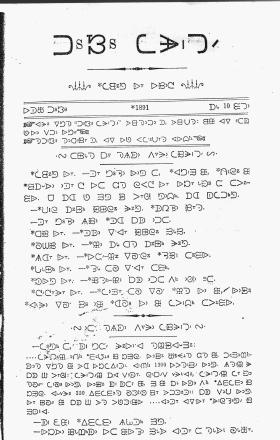
Between 1891 and 1894 a newspaper was
published in syllabics at Naka'zdli (Fort Saint James) six times a year.
Here is the first page of the first issue, dated October 1891.
One of the longest texts in syllabics by a Dakelh person is seven page
submission from Nak'az̲dli to the McKenna-McBride Commission in 1915.
Here is the first page. (Unfortunately, it is rather difficult to read.)

There are several dozen gravestones with inscriptions in syllabics.
Here is the grave of Agatha John Thomas from the
Saik'uz graveyard. Clicking on a character will cause
the equivalent in the Carrier Linguistic Committee writing system to
appear at the bottom of the page.
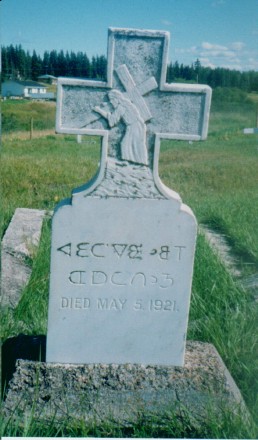
The Dakelh portion of the inscription reads
Ba tenadondli
This means: "Agatha's grave. Pray for her."
Here is the grave of a woman named Belzeni (from French Virginie)
from the Nak'azdli graveyard. Clicking on a character will cause
the equivalent in the Carrier Linguistic Committee writing system to
appear at the bottom of the page.
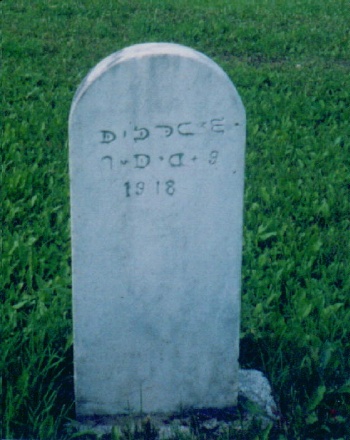
The inscription reads:
Novembar 9
1918
This means: "Virginia died November 9, 1918."
This gravestone illustrates the way in which Dakelh people introduced devices for representing sounds not native to Dakelh. The system as introduced by Father Morice provided only for sounds native to Dakelh. When Dakelh people borrowed words from English and French, they sometimes kept unfamiliar sounds such as /r/ and /v/. The use of the v-like symbol that represents /k'/ followed by a /b/-series symbol (here /be/) to represent /v/ is one such innovation. The little cross that represents the /r/ of "November" is another of these innovations.
[Note: we have given the text of these inscriptions as it would now be correctly written. In fact, these inscriptions, like most inscriptions on gravestones, contain errors and omissions. For example, in Virginia's gravestone the letter that should represent /i/ is missing the triangle that should surround the dot.This is partly due to spelling conventions that we cannot go into here and partly due to the fact that most of the gravestones were ordered from the Hudson's Bay Company and were carved in Victoria by people who were merely copying an inscription that they did not understand in a writing system with which they were not at all familiar.]
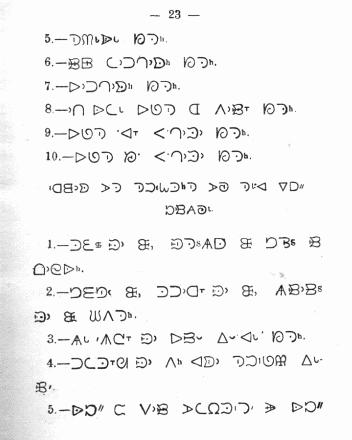
One of the most widely read publications in the syllabics was the Roman Catholic prayerbook. Many people learned to read Dakelh from this book. Here is a page from the 1933 edition. At the top of the page are the fifth through tenth of the Ten Commandments. The Fifth Commandment reads ne-so-lh-ghe-lh ju-ni-h ``do not kill people''.
Syllabics are not very widely used anymore, but there has been a resurgence in interest. Until he passed away in 2004 Nak'azdli elder Nick Prince used to teach classes on syllabics from time to time. In many places they are considered appropriate for formal purposes even though only a few people can read them. For example, when a plaque was put up in the Ulkatcho Learning Centre in Anahim Lake in 1993 in honour of the late Chief Jimmy Stillas, the text was written in four languages: Ulkatcho dialect Dakelh, Nuxalk, Chilcotin, and English, with the Dakelh written both in the Carrier Linguistic Committee writing system and in syllabics. Here is a photograph of the plaque just before it was put up.

A textbook of the syllabics is available: Introduction to the Carrier Syllabics. You can download the pdf here
Several Unicode fonts are available that include the Carrier syllabics as part of the larger Unified Canadian Aboriginal Syllabics set. We recommend the fonts created by LanguageGeek. The font itself is oskidakelh.zip. Here are instructions on how to install fonts.
The converter at http://www.translitteration.com/transliteration/en/carrier/canadian-aboriginal-syllabics/ is incorrect and should not be used. Try this transliterator instead.
LanguageGeek also has available keyboard maps for typing in syllabics. One allows you to type in the Carrier Linguistic Committee system and converts on the fly to dulkw'ahke. The other assigns dulkw'ahke characters to single keys. These keyboards work on Microsoft Windows and Macintosh OS X systems and allow you to type in syllabics in programs such as Microsoft Word and OpenOffice.org Writer.
A simple text editor that allows dulkw'ahke to be entered by typing in the Carrier Linguistic Committee writing system is the Yudit Unicode text editor, downloadable at no cost from http://www.yudit.org/. Yudit runs on UNIX systems, including GNU/Linux, and Microsoft Windows. Further information on using Yudit to write in syllabics is available here..
A detailed explanation of the syllabics aimed at linguists is given in the paper The Carrier Syllabics. To download a copy, go to the download page.
| HOME | BACK |
Yinka Déné Language Institute © 2006-2026